
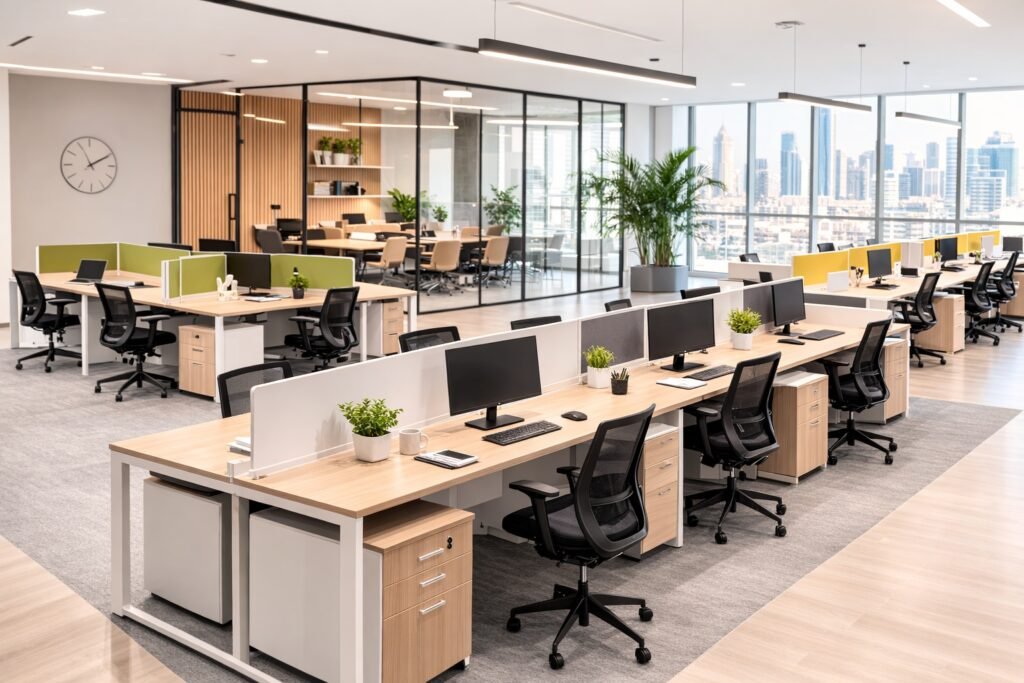
Designing an efficient office is not just about choosing desks and chairs. The way workstations are arranged plays a big role in how teams collaborate, communicate, and stay productive throughout the day. Well-planned office workstation layouts help businesses maximize available space while creating a comfortable and organized work environment.
Modern offices often move away from traditional cubicles and adopt layouts that support teamwork and flexibility. Choosing the right layout can make a noticeable difference in employee interaction, workflow, and overall office efficiency. Many companies now focus on modern office workstation designs that support open and collaborative work environments.In this guide, we will explore some of the most common and effective office workstation layouts used in modern workplaces.
Linear Workstation Layout
A linear workstation layout places desks in a straight line, usually along a wall or in long rows. This setup works well in offices with narrow spaces or long floor plans where maximizing desk placement is important.This type of office workstation design and layout is often used in structured office environments where teams work independently but still share the same space.
Why businesses choose linear layouts
Efficient use of long spaces
Linear layouts are ideal for offices that have rectangular or narrow floor plans. Placing workstations in rows helps maintain clear walkways and organized desk arrangements.
Simple and structured design
This layout keeps the workspace tidy and predictable, which can help employees focus on their tasks without distractions.
Easy to expand
Additional desks can easily be added to extend the row as the team grows.
Linear workstation layouts are commonly used in administrative offices, support teams, and departments where employees perform similar tasks.
Cluster Workstation Layout
The cluster workstation layout groups desks together in small teams. Instead of lining desks in rows, several workstations are arranged in a square or circular formation so employees face each other.
Where cluster layouts work best
Team-based departments
Departments such as marketing, development, or project teams benefit from close collaboration, which cluster layouts naturally encourage.
Improved communication
Employees can easily interact with team members without needing to move around the office.
Better team coordination
Since everyone in the team sits close together, it becomes easier to share ideas and work on group tasks.Cluster workstation layouts are especially popular in modern companies where teamwork and collaboration are an important part of daily work and are often part of modern office workstation designs used in collaborative offices.
Bench Workstations
Bench workstations are one of the most popular layouts in modern office workstations. In this design, long desks are shared by multiple employees sitting side by side.
This layout creates an open and collaborative work environment where teams can work closely together while still maintaining individual workspace areas.
Benefits of bench workstations
Encourages collaboration
Employees can easily interact and exchange ideas without physical barriers between desks.
Clean and modern appearance
Bench workstations create a minimalist office design that feels open and organized.
Efficient use of space
By removing bulky partitions, offices can accommodate more employees while keeping the environment spacious.
Bench layouts are widely used in startups, creative teams, and companies that prioritize open communication.
Modular Office Workstations
Modular office workstations are designed for flexibility. Instead of fixed desk arrangements, modular systems allow desks to be rearranged or expanded depending on the needs of the office.
This makes them one of the most practical solutions for companies that expect growth or regularly reorganize teams.
Why modular workstations are popular
Flexible office layouts
Modular workstations can be arranged in different configurations such as clusters, rows, or collaborative pods.
Adaptable for growing teams
When new employees join the company, additional modules can easily be added to the existing workstation setup.
Supports modern office environments
Many modern office workstations use modular systems because they combine flexibility with efficient space planning.Businesses looking for flexible workspace solutions can browse modular workstation desks in Dubai for flexible office layouts designed for collaborative offices and growing teams.
Choosing the Right Workstation Layout
Selecting the right workstation layout depends on several factors, including office size, team structure, and the type of work employees perform.
For example:
- Linear layouts work well in narrow office spaces.
- Cluster layouts are ideal for team collaboration.
- Bench workstations support open office workstation layouts commonly used in modern companies.
- Modular workstation systems offer flexibility and scalability.
When designed carefully, the right workstation layout can improve productivity, encourage teamwork, and create a workspace that supports both employees and business growth.
Modern workplaces continue to evolve, and companies that invest in well-planned workstation layouts often create more efficient and comfortable environments for their teams.